
Identity Is the New Security Perimeter
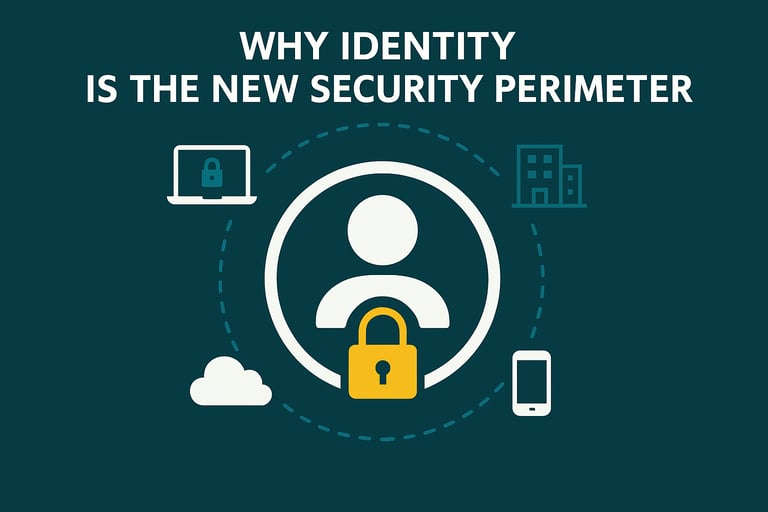
For decades, cybersecurity was built around a simple assumption: if you protect the network boundary, you protect everything inside it. Firewalls, VPNs, and intrusion detection systems formed a strong digital wall around corporate infrastructure.
That assumption no longer holds true.
In today’s cloud‑first, remote‑work world, identity has replaced the network as the primary security perimeter. Organizations that fail to recognize this shift are often the ones most vulnerable to modern cyberattacks.
Why Identity Is the New Security Perimeter?
The Fall of the Traditional Network Perimeter
Cybercriminals have evolved along with technology. Instead of attacking hardened network infrastructure, they go after your identities.
Common attack methods today include:
Phishing emails to steal credentials
Password spraying and credential stuffing
Session token theft
Abuse of over‑privileged service accounts
Once attackers gain access to valid credentials, traditional security tools often see them as legitimate users. At that point, firewalls and VPNs offer little protection.
This shift explains why credential‑based attacks are involved in the majority of modern security breaches.
The traditional perimeter model was designed for a different era—one where:
Employees worked from corporate offices
Applications lived in on‑premises data centers
Devices were company‑owned and centrally managed
Modern IT environments look very different:
Employees work remotely and use multiple devices
Applications run in SaaS platforms like Microsoft 365 and Google Workspace
Data lives in the cloud and is accessed over the public internet
Partners and contractors require controlled access
There is no longer a clear “inside” or “outside” of the corporate network. Relying on IP addresses or VPN access as a trust signal is no longer sufficient.
Modern security strategies are increasingly built around Zero Trust, a model based on one core principle:
Never trust, always verify.
In a Zero Trust architecture:
No user or device is trusted by default
Every access request must be authenticated and authorized
Trust is continuously evaluated, not granted once
Identity enables Zero Trust by allowing organizations to evaluate:
Who the user is
Whether the sign‑in behavior is risky
The health and compliance of the device
The sensitivity of the resource being accessed
Technologies such as Multi‑Factor Authentication (MFA), Conditional Access, and risk‑based authentication all depend on strong identity foundations.
Identity Goes Beyond Users
Cloud and SaaS Are Built on Identity
Zero Trust: Identity at the Core
Attackers Target Identities, Not Firewalls
Cloud platforms are inherently identity‑driven.
In platforms such as Microsoft Azure, AWS, and Google Cloud:
Access is granted via Identity and Access Management (IAM)
Permissions are tied to users, devices, and workloads—not network location
Authentication happens via protocols like OAuth, OpenID Connect, and SAML
For example:
Access to Microsoft 365 depends on user identity and conditional policies
Azure resources are secured using role‑based access control (RBAC)
APIs authenticate using tokens rather than IP addresses
In cloud environments, identity is the control plane.
Context Matters More Than Location
The shift from network‑centric security to identity‑centric security is not optional—it is a fundamental requirement of modern IT.
Networks are no longer fixed.
Applications are no longer on‑premises.
Users are no longer in one place.
Identity is the only security control that consistently follows users, devices, and workloads wherever they go.
That is why identity is the new security perimeter—and why securing identity is now one of the most critical responsibilities in cybersecurity.
Identity‑centric security is not only about reducing risk—it also enables the business.
Strong identity security:
Supports remote and hybrid work
Reduces reliance on VPNs
Simplifies partner and guest access
Improves user experience without sacrificing security
Accelerates cloud adoption
When implemented correctly, identity allows organizations to securely say “yes” instead of defaulting to “no.”
Modern identity security extends beyond human users.
Organizations must secure:
User identities – employees, admins, contractors
Device identities – laptops, mobile devices, kiosks
Workload identities – applications, APIs, services, automation
Workload identities are often the most dangerous when compromised, as they:
Operate continuously
Tend to have excessive permissions
Are rarely monitored as closely as human users
Treating identity as the new perimeter means securing all types of identities, not just people.
Conclusion
Business Enablement, Not Just Protection
Identity‑based security enables context‑aware access decisions.
Instead of asking, “Is the user inside the corporate network?”, modern systems ask:
Is the sign‑in coming from a trusted device?
Is the location unusual?
Has risky behavior been detected?
Should additional verification be required?
For example:
A user may access email normally from a managed device
The same user may be required to complete MFA when accessing sensitive data from a new location
Access may be blocked entirely if high risk is detected
This level of granularity is impossible with traditional perimeter‑based security.